
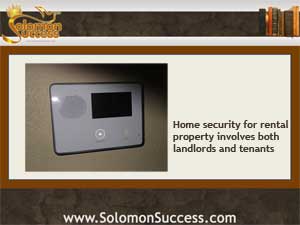
 King Solomon’s often-quoted advice on financial management is solidly based on the idea of prudence and wisdom – two similar but not identical concepts that have to do with heading off trouble at the pass. For owners of income property, the issue of home security on residential property is one that can benefit from a hefty dose of both prudence and wisdom in order to stay legal, address tenant concerns and avoid lawsuits.
Certain kinds of basic home security fall under a landlord/investor’s legal responsibilities. It’s a landlord’s duty to provide doors with working locks and appropriate indoor and outdoor lighting. The landlord/tenant rules in all states require landlords to provide a working smoke detector, too, and in some states, even a carbon monoxide detector. And security in common areas such as sidewalks and laundry facilities is always a landlord’s responsibility
Although homeowners are flooded with advertising for the latest in home security technology, landlords are under no obligation to provide advanced security systems, alarms or surveillance hardware. If landlords do install these things, though, it’s their responsibility to maintain them in good working order, or they could be held liable if an incident occurs.
Tenants can – and do – install their own security devices, and that’s an area that requires clear guidelines, preferably in the lease or rental agreement, to prevent major problems. Generally, tenants need to get a landlord’s permission before installing any kind of security system or making changes to existing ones, and landlords aren’t obligated to maintain these kinds of systems. If a tenant signs a contract with an alarm system provider, for example, and then moves away before the contract term is up, the landlord isn’t responsible for carrying that contract.
A thornier area, though, is the question of access to the property. Landlords can legally enter properties under certain circumstances, and that can cause problems unless the issue is clearly addressed in the lease. Both tenants and landlords must have keys to the property, and if a landlord has installed other security, both parties need to have the security codes at other means of accessing it.
If a tenant installs an alarm system that requires a code, the landlord has a right to ask for the code in order to exercise the right of legal access to the property, which includes emergencies, scheduled repairs and showing to prospective tenants.
If you ‘re building wealth through investment property as Jason Hartman recommends, keeping that property secure is the job of both you and your tenants. Clarifying those responsibilities from the outset in writing protects both parties – and your property. (Top image: Flickr/pussanos)
Source:
Ferland, Carrie. “Do Landlords Have an Obligation to Protect Their Tenants?” SFGate Homeguides. HomeguidesSFGate.com 29 Aug 2013
Solomon Success is the complete solution for Christian investors. Read more from our archives:
QM Rule Updates May Help Housing Recovery
What Does the Fed Mean to You?
The Solomon Success Team